EV transition in India is already underway.
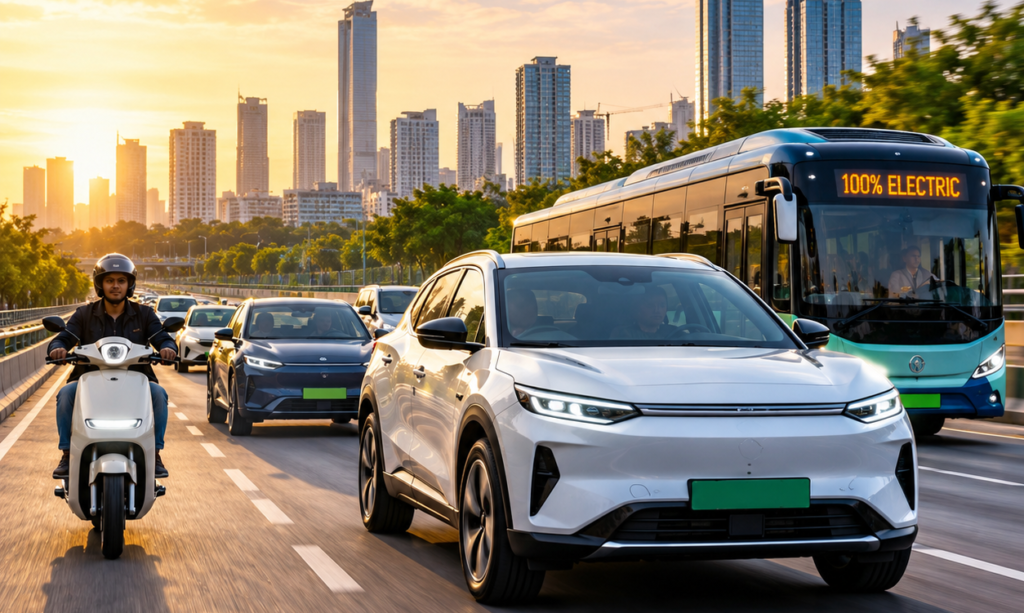
India is slowly changing the way it moves.
For decades, Indian roads have been dominated by petrol and diesel vehicles. From motorcycles and scooters to hatchbacks, SUVs, buses and trucks, the internal-combustion engine has been at the centre of everyday mobility.
But a different kind of vehicle is becoming increasingly visible.
Electric vehicles.
And the important question is no longer simply whether EVs will become part of India’s transportation system.
They already are.
The bigger question is:
What will India’s roads, vehicles, charging network and driving experience look like over the next ten years?
India’s EV transition will not happen overnight, and it will not affect every vehicle category at the same speed.
But the direction is becoming increasingly clear.
According to India’s Ministry of Heavy Industries, registered EVs increased from 1.74 lakh in FY2019-20 to 19.68 lakh in FY2024-25. EV penetration among registered vehicles reached 7.50% in FY2024-25, compared with 0.71% in FY2019-20.
That is still a minority of India’s overall vehicle fleet.
But it is large enough to show that India’s transportation system has already begun changing.
So, what happens next?
What Exactly Is India’s EV Transition?
The term EV transition can sound as if it simply means replacing petrol cars with electric cars.
It is much bigger than that.
India’s EV transition involves a gradual shift from an ecosystem based around:
Petrol + diesel + engines + fuel stations
towards one increasingly built around:
Electricity + batteries + motors + charging networks + software.
That means the transition affects much more than the vehicle itself.
It involves:
- Vehicle manufacturers
- Battery manufacturers
- Charging companies
- Electricity distribution companies
- Renewable-energy producers
- Software and semiconductor companies
- Fleet operators
- Public transport
- Recycling companies
- Consumers
- Government policy
In other words, India’s EV transition is really a transition in the entire mobility ecosystem.
1. India’s EV Transition Has Already Started
The numbers are important because they provide a better picture than headlines.
Government data shows that registered EVs rose from 4.59 lakh in FY2021-22 to 11.83 lakh in FY2022-23, 16.81 lakh in FY2023-24 and 19.68 lakh in FY2024-25.
But one of the most important things to understand is that India’s EV transition is not happening equally across all vehicle categories.
Two-wheelers and three-wheelers have become particularly important.
The International Energy Agency identifies India’s electric two- and three-wheeler segment as one of the country’s most advanced EV markets. In its 2025 outlook, the IEA noted that nearly 10% of 2/3W sales in India were electric in 2024.
This tells us something important:
India’s EV transition is not beginning with luxury electric cars.
It is also being driven by everyday mobility.
2. The Indian Road Will Become More Electric — But Unevenly
One of the biggest mistakes in discussing the future of EVs is assuming that every category will electrify at the same speed.
It probably won’t.
A person who uses a scooter for commuting every day has a very different set of requirements from someone who drives an SUV hundreds of kilometres on an interstate trip.
A city delivery vehicle has different economics from a long-haul truck.
A bus operator has different priorities from a private-car owner.
This means India’s EV transition is likely to develop in layers.
Electric Two-Wheelers
Electric two-wheelers are likely to remain one of the most important parts of India’s EV story.
Their relatively smaller batteries, frequent urban use and potential operating-cost advantages make electrification particularly relevant.
Electric Three-Wheelers
Three-wheelers are another major part of India’s transition.
India is already the world’s largest electric three-wheeler market, and the IEA reported that electric three-wheeler sales in India rose to almost 800,000 in 2025, a 15% increase from 2024.
For commercial operators, operating economics can be more important than simply the purchase price.
Electric Buses
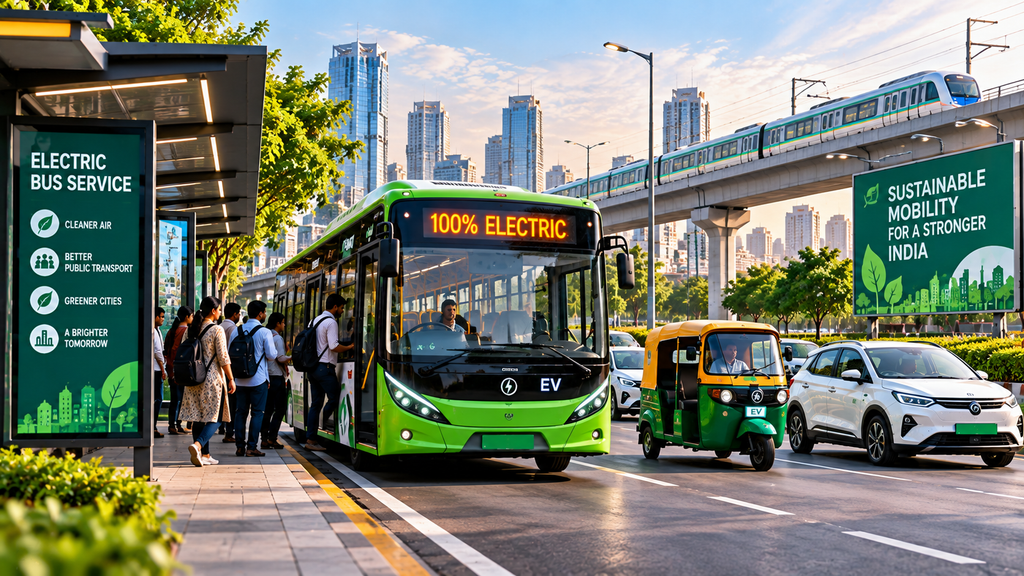
Electric buses can change urban transportation in a very visible way.
Instead of thousands of individual private vehicles becoming electric one at a time, a single electric bus can carry many passengers every day.
The PM E-DRIVE programme includes support for electric buses, with ₹4,391 crore allocated for procurement of 14,028 electric buses through public transport agencies.
Electric Cars
Electric cars are likely to grow, but the transition faces different challenges here.
Higher upfront prices, charging availability, apartment parking, highway travel and consumer concerns about range all influence the decision.
Electric Trucks
Heavy-duty electric trucks may take longer to scale because they require large batteries, high-power charging and careful attention to payload, route length and charging downtime.
The transition therefore won’t be:
“Everything becomes electric at once.”
It will be:
“Different parts of transportation electrify when the economics and infrastructure make sense.”
3. Charging Will Become as Important as the Vehicle
Imagine buying an EV today.
The question isn’t only:
“How far can it travel?”
Another question is:
“Where can I charge it?”
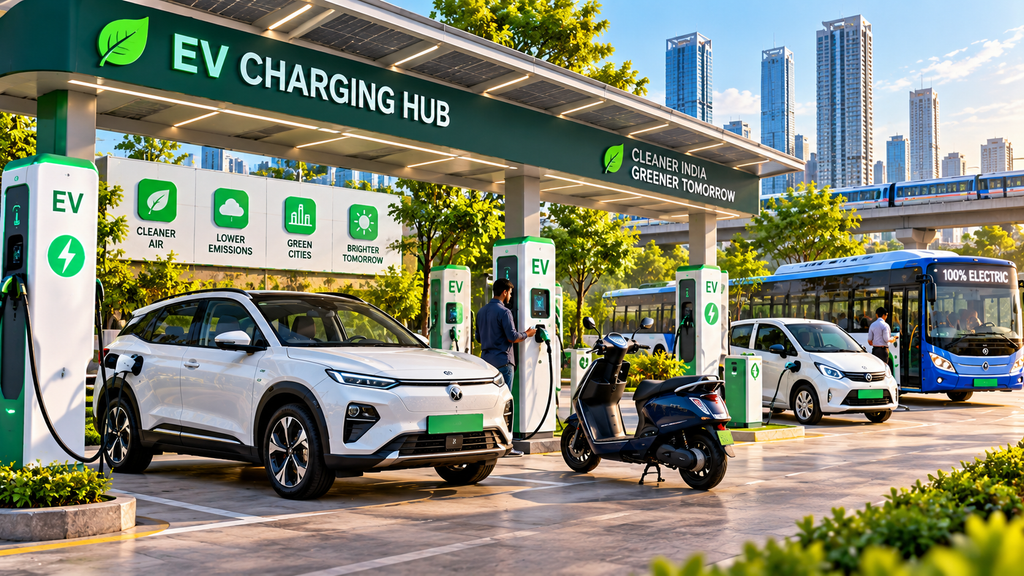
This is why charging infrastructure will be one of the defining elements of India’s EV transition.
The Ministry of Power issued the Guidelines for Installation and Operation of Electric Vehicle Charging Infrastructure-2024, covering charging infrastructure in private parking spaces, offices, educational institutions, hospitals, housing societies, public locations and highways.
The framework is intended to support a charging network that is safe, reliable and accessible.
Over the next decade, charging is likely to become less of an occasional search and more of an ordinary part of travel.
A future driver may think about charging in much the same way today’s driver thinks about fuel:
Where am I going?
How much energy do I need?
Where is the next convenient charging point?
4. Home Charging Could Become the Normal Starting Point
One major difference between EVs and conventional vehicles is that an EV can often be charged where it is parked.
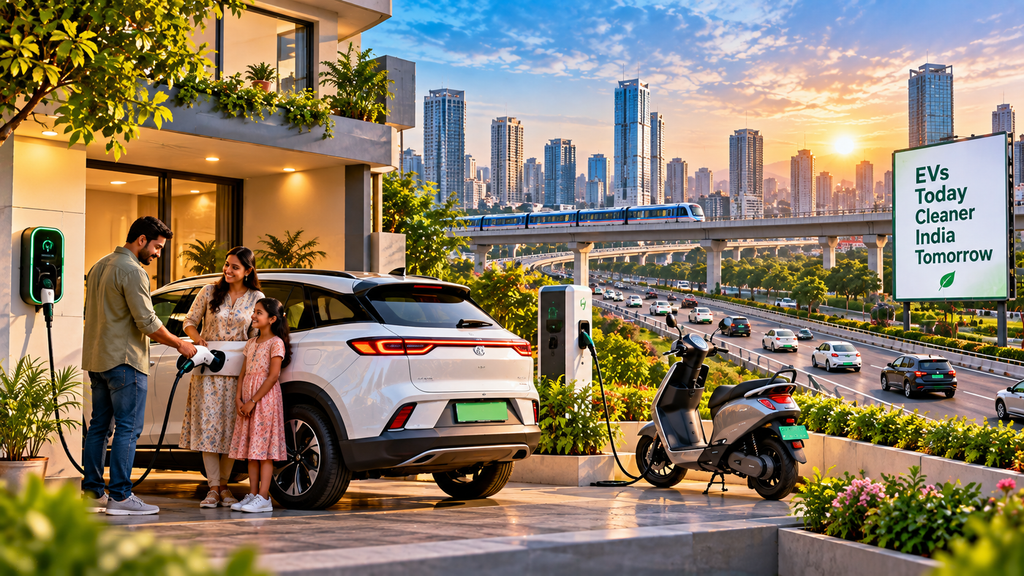
For many private EV owners, the most important charger may not be a highway fast charger.
It may be the charger at home.
Imagine returning home in the evening, plugging in the car and starting the next morning with a charged battery.
That changes the concept of “refueling.”
Instead of making a special trip to a fuel station, charging can become part of the normal parking routine.
Of course, this is easier for homeowners with dedicated parking than for people living in buildings where parking and electrical infrastructure are shared.
That makes apartment charging an important issue for India’s EV transition.
The Ministry of Power’s 2024 framework also allows residential owners to use existing electricity connections for EV charging or opt for a separate metered connection with a dedicated EV charging tariff.
Over the next decade, housing societies, commercial buildings, offices and parking facilities are likely to become increasingly important parts of the charging ecosystem.
5. The Battery Will Become One of the Most Important Parts of the Automobile
In a conventional vehicle, the engine is at the heart of the pow
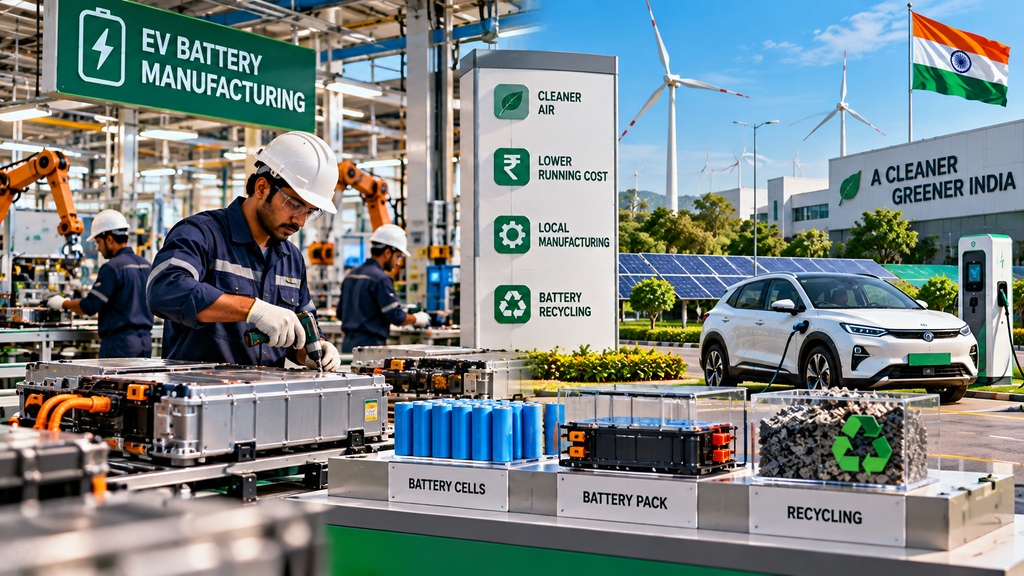
ertrain.
In an EV, the battery becomes one of the most important components.
Battery improvements can affect:
- Driving range
- Charging speed
- Vehicle weight
- Performance
- Cost
- Durability
- Safety
- Resale value
And this is where the EV transition becomes more than an automotive story.
It becomes a manufacturing and energy story.
India has been supporting domestic advanced automotive and battery manufacturing through programmes including the Production Linked Incentive scheme for automobiles and auto components.
The PLI-Auto scheme has an approved budgetary outlay of ₹25,938 crore.
Building domestic capabilities matters because batteries represent a major part of an EV’s value.
6. Battery Recycling Will Become a Major Industry
There is another side to the battery story.
What happens when an EV battery reaches the end of its useful vehicle life?
The answer cannot simply be:
Throw it away.
India already has a regulatory framework for battery waste management.
The Battery Waste Management Rules, 2022, together with subsequent amendments, provide the regulatory framework for battery waste management in India.
Over the next decade, battery recycling and recovery are likely to become increasingly important.
The future EV ecosystem will therefore not end when a vehicle leaves the road.
There will be another chain after that:
Vehicle → Battery → Second-life applications / Recycling → Material recovery → New batteries
As India’s EV fleet grows, the ability to recover valuable materials from used batteries will become increasingly important.
7. EVs Will Become Increasingly Connected to the Electricity Grid
There is another major change that many drivers may not notice immediately.
An electric vehicle is not only a vehicle.
It is also a large electrical load connected to the power system.
Millions of EVs charging at the same time could create new electricity-demand patterns.
But smart charging can also create opportunities.
Charging can potentially be shifted toward periods when electricity is cheaper or when renewable electricity is more available.
That means future EVs may communicate not only with their owners but also with charging networks and energy systems.
The automobile is becoming increasingly connected to the digital and electrical infrastructure around it.
8. Renewable Energy Will Matter to the EV Transition
An EV has no tailpipe emissions while driving.
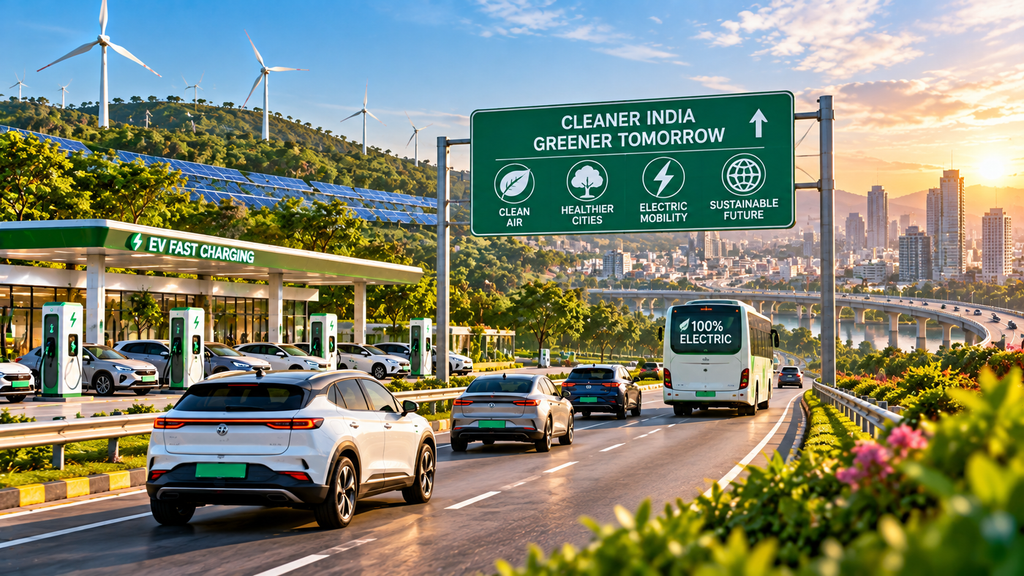
But the electricity used to charge it has to come from somewhere.
That makes the electricity mix important when discussing the environmental benefits of electrification.
As India’s electricity system incorporates more non-fossil generation, the relationship between EVs and emissions can change further.
This means the EV transition is connected to another transition:
Transport electrification + electricity-sector transformation.
The two systems will increasingly influence each other.
9. Petrol Pumps Won’t Disappear Overnight
One common question is:
“Will petrol pumps disappear?”
The most realistic answer is that the transition will take time.
India has a huge installed base of petrol and diesel vehicles.
Even if EV sales grow rapidly, millions of existing internal-combustion vehicles will continue operating for years.
This means India will probably have a mixed vehicle fleet for a long time.
Petrol and diesel vehicles will continue to exist alongside EVs.
At the same time, some fuel stations may add EV charging.
The traditional fuel station could therefore evolve into something different:
Fuel + fast charging + food + parking + convenience services + fleet services.
The transition is not necessarily about one infrastructure disappearing overnight.
It is about the infrastructure around mobility changing.
10. The Biggest Change May Be the Economics of Driving
For consumers, the EV transition is ultimately about more than technology.
It is about money.
The purchase price of an EV can be higher or lower than a comparable conventional vehicle depending on the segment, model and incentives.
But the more useful comparison is often total cost of ownership.
That can include:
- Purchase price
- Financing
- Electricity
- Fuel
- Maintenance
- Insurance
- Taxes
- Battery-related costs
- Resale value
- Charging costs
The IEA has found that electric two-wheelers in India can offer significant total-cost-of-ownership advantages under certain conditions. Its analysis estimated that, with subsidies, an average electric two-wheeler could have a five-year TCO around 40% lower than its internal-combustion equivalent in its earlier assessment.
But this does not mean every EV is automatically cheaper for every owner.
The calculation depends on usage, electricity prices, financing, vehicle price, maintenance, charging access and ownership period.
The better question is:
“Is this particular EV cheaper for my particular usage?”
That is the kind of question AUTOPATH.IN should help readers answer.
11. Government Policy Will Continue to Influence the Transition
Government policy has played a significant role in India’s EV development.
One of the key current programmes is PM E-DRIVE.
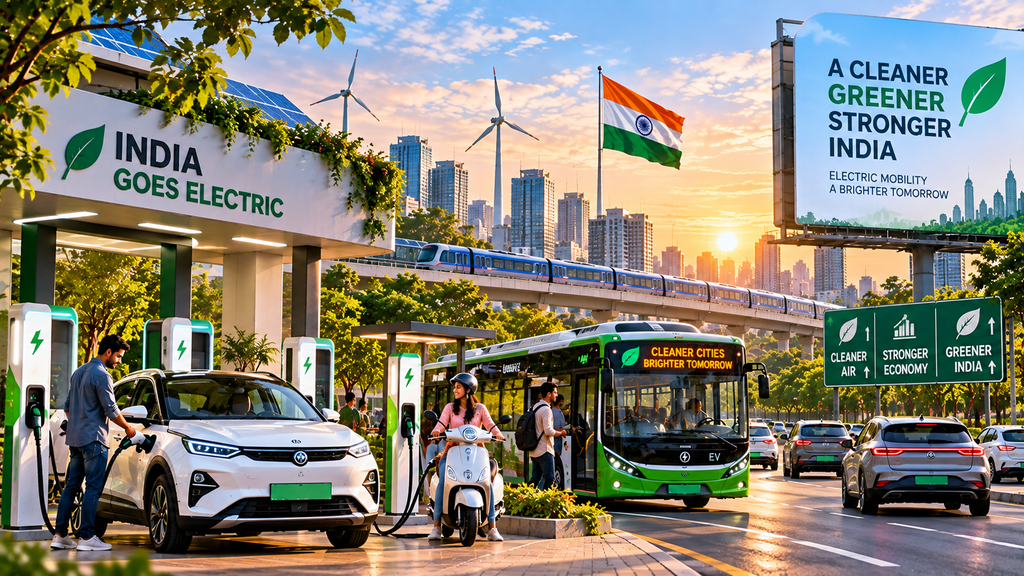
The scheme was launched in 2024 with an initial outlay of ₹10,900 crore.
It supports areas including electric two-wheelers, three-wheelers, buses, trucks, ambulances and charging infrastructure.
The programme has since been extended, and the official PM E-DRIVE portal now lists the scheme through 31 March 2028, with subsequent amendments to individual vehicle categories.
Government support matters because EV economics can be influenced by:
- Purchase incentives
- Manufacturing incentives
- Tax treatment
- Charging policies
- State-level EV policies
- Local manufacturing
- Battery policies
- Public transport programmes
But government support is only one part of the equation.
For EVs to become a durable mass-market technology, the underlying economics and consumer experience also have to work.
12. EV Transition in India Will Create New Industries
A change this large doesn’t only affect car companies.
It creates opportunities across an entire ecosystem.
Consider what an EV needs:
Battery cells
Battery packs
Motors
Power electronics
Semiconductors
Charging equipment
Charging software
Energy management
Fleet management
Battery recycling
Vehicle software
Diagnostic systems
Insurance
Financing
Maintenance
Second-life batteries
This means the EV transition could reshape India’s broader automotive supply chain.
The traditional automobile industry will remain important, but its composition will change.
The mechanic of the future may need to understand high-voltage systems.
The service centre may become more software-driven.
The dealership may sell charging solutions alongside vehicles.
And automotive companies may increasingly compete on software, battery efficiency and energy management—not just engine performance.
13. The Driving Experience Itself Will Change
An EV doesn’t simply replace an engine with a battery.
It can change how a vehicle feels.
Electric motors can deliver torque quickly.
Regenerative braking can allow drivers to slow the vehicle while recovering some energy.
Software can control driving modes, battery management, charging and other vehicle functions.
Vehicles are also becoming increasingly connected.
This means the definition of a car is gradually changing.
It is becoming a combination of:
Hardware + battery + software + connectivity + energy.
That may become one of the biggest conceptual changes in the automobile industry over the next decade.
14. What Could India’s Roads Look Like by 2035?
No one can know exactly what Indian roads will look like in 2035.
The outcome will depend on battery prices, consumer demand, charging infrastructure, government policy, electricity supply, vehicle prices and technological developments.
But scenario analysis can help us understand the possible direction.
The IEA’s 2024 Global EV Outlook projected that, under its Stated Policies Scenario, electric light-duty vehicles could represent about one-quarter of light-duty vehicle sales in India in 2035. Its scenario for all road modes put India’s EV sales share at around 50% in 2035 when two- and three-wheelers are included.
These are scenarios, not guaranteed forecasts.
They demonstrate something important, however:
The scale of India’s EV transition could be substantial even if electrification progresses at different speeds across vehicle categories.
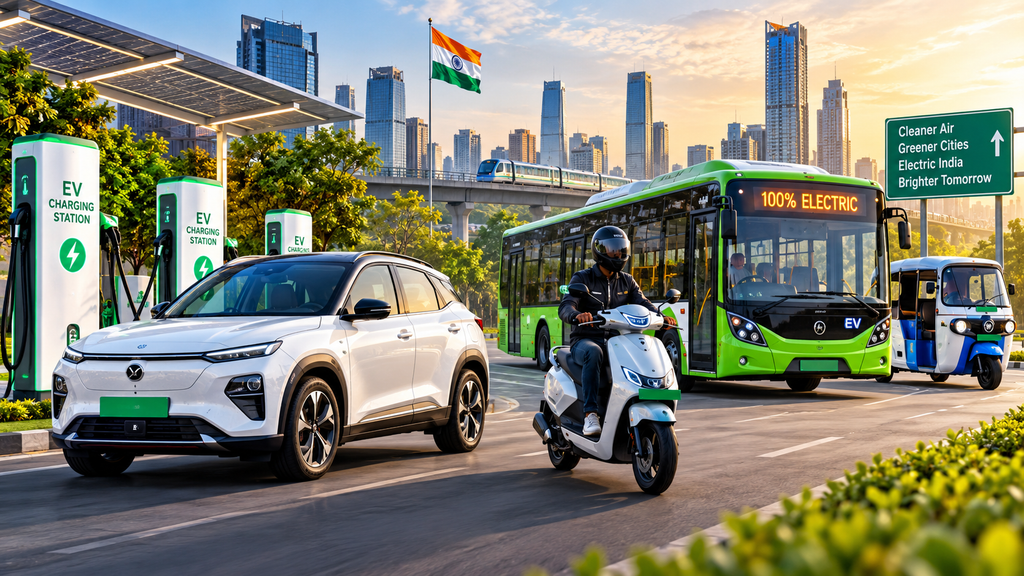
By 2035, a typical Indian city could have:
- Large numbers of electric scooters
- More electric three-wheelers
- Increasing numbers of electric cars
- Electric buses on major routes
- More charging points at workplaces and shopping areas
- Faster highway charging
- More EV-focused service centres
- Battery recycling facilities
- More software-connected vehicles
But petrol and diesel vehicles are also likely to remain on the roads.
The transition will therefore look less like a switch being turned off and more like a long transformation of the fleet.
15. The Biggest Challenges Are Still Ahead
It would be easy to describe the EV transition as inevitable and effortless.
It isn’t.
Several challenges remain.
Charging Access
Public charging needs to become easier, more reliable and easier to find.
Apartment Living
Millions of urban residents do not have a private garage.
Shared charging infrastructure will therefore matter.
Upfront Prices
EVs need to become affordable for a broader range of Indian consumers.
Long-Distance Travel
Highway charging must become sufficiently widespread and dependable for drivers who regularly travel long distances.
Battery Durability
Consumers will want confidence about battery life, degradation, replacement costs and resale value.
Recycling
The battery lifecycle needs to become increasingly circular.
Electricity Demand
Large-scale electrification will increase electricity demand and require careful grid planning.
Consumer Education
Many buyers still have questions about range, charging, maintenance and ownership.
The transition will succeed not simply when EVs are available.
It will succeed when ordinary people understand them and trust the ecosystem around them.
16. The Next Ten Years Won’t Be About “EV vs Petrol”
The debate is often presented as a simple competition:
EV vs Petrol.
But India’s real transition is more complicated.
The next decade will involve questions such as:
Which vehicle is right for which driver?
Which segment electrifies first?
How quickly will charging improve?
How affordable will batteries become?
How will cities adapt?
How will electricity systems adapt?
What happens to old batteries?
What happens to the existing petrol and diesel fleet?
And perhaps the biggest question:
Can India build an EV ecosystem that works at massive scale?
The Road Ahead
EV transition in India is not a distant idea waiting to begin.
It has already begun.
The numbers show rising EV registrations. Electric two- and three-wheelers are becoming increasingly important. Government policy is supporting parts of the ecosystem. Charging infrastructure is being formalised and expanded. Battery manufacturing and recycling are becoming strategic industries. And the electricity system itself is changing.
But the next ten years will determine how deep that transition really becomes.
The most important change may not be the day when an EV becomes more common than a petrol car.
It may be the gradual moment when charging becomes normal, batteries become familiar, electric mobility becomes economically practical, and consumers stop thinking of an EV as something unusual.
That is when a transition becomes a transformation.
India’s roads of 2035 may still contain petrol, diesel, hybrid and electric vehicles together.
But the role of electricity in transportation could be dramatically larger than it is today.
And that is why India’s EV transition is not simply a story about cars.
It is a story about how India will move.
Frequently Asked Questions
Is India moving toward electric vehicles?
Yes. Government data shows a substantial increase in registered EVs over recent years, although EVs still represent a minority of India’s overall registered vehicle fleet. EV adoption also varies considerably by vehicle category.
Which EV segment is growing fastest in India?
Electric two- and three-wheelers have been particularly important to India’s EV transition. Their usage patterns and operating economics can make electrification attractive, particularly for high-utilisation vehicles.
Will petrol and diesel cars disappear by 2035?
There is no basis for saying that all petrol and diesel vehicles will disappear by 2035. India’s existing fleet is very large, and vehicle replacement takes many years. EVs are likely to grow alongside the existing internal-combustion fleet.
Will India have enough EV charging stations?
India is actively developing and regulating charging infrastructure. The Ministry of Power’s 2024 guidelines cover private, semi-public, public and highway charging infrastructure. The scale and reliability of the network will remain an important factor in EV adoption.
Are EVs cheaper to own?
It depends on the vehicle and the owner’s usage. Electricity, maintenance, purchase price, financing, charging access and annual kilometres all affect total cost of ownership.
What will happen to old EV batteries?
India has a battery-waste regulatory framework, including the Battery Waste Management Rules, 2022 and subsequent amendments. Recycling and material recovery are expected to become increasingly important as the EV fleet grows.
What is the biggest challenge for India’s EV transition?
There isn’t one single challenge. Affordability, charging infrastructure, battery technology, electricity demand, consumer confidence, recycling and policy consistency all matter.
Sources & Further Reading
- Ministry of Heavy Industries — EV registration and penetration data.
- Ministry of Heavy Industries — PM E-DRIVE official information.
- Ministry of Power — EV Charging Infrastructure Guidelines 2024.
- International Energy Agency — Global EV Outlook 2025.
- International Energy Agency — Global EV Outlook 2024.
Last researched: September 2026